
Custom Poker Cards — Casino-Grade Decks Printed in the USA
This page is about how a poker deck performs once it is in play — riffle, fan, squaring up, and how long it lasts before the corners give out. Poker size is 2.5 × 3.5 inches, we press more of it than anything else, and the specification choices that matter here are different from the ones that matter on a gift deck.
- Minimum
- 15 decks
- Turnaround
- 2–4 weeks
- Printed in
- Orlando, FL
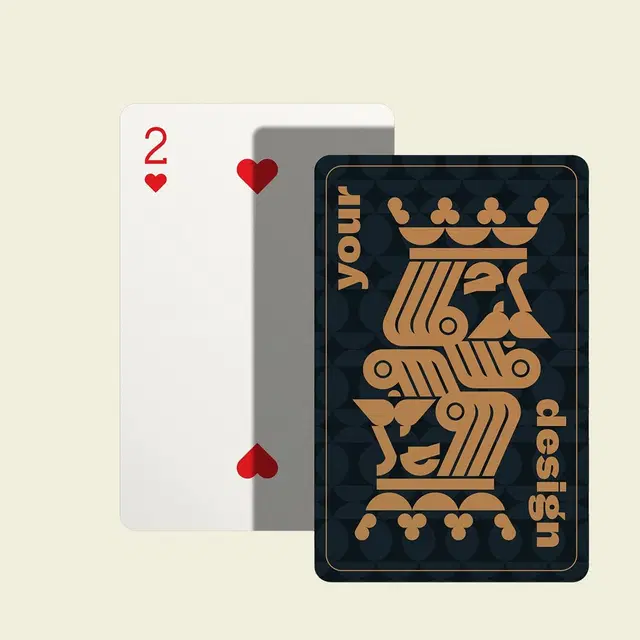
What size are custom poker cards?
Custom poker cards use the familiar 2.5 by 3.5 inch trim size, which fits standard gameplay, sleeves, cases, and most poker accessories. Artwork should extend 0.125 inch beyond the trim for bleed, with important text and logos kept inside the safe zone.
What stock is best for custom poker cards?
300 GSM black-core stock is the practical all-round choice for custom poker cards because the opaque center prevents faces from showing through the backs. Choose 310 GSM linen or deluxe stock for a more premium feel, or waterproof 100% plastic for heavy-use environments.
How many custom poker cards are in a deck?
A traditional poker deck has 52 cards plus jokers, but a custom poker deck can contain any card count your project needs. Card count affects collation and packaging depth; the quote depends on the complete specification, including quantity, stock, and box choice.
- Opaque under table light
Black core or plastic — no face reads through the back from across the table.
- Releases on the riffle
Slip coating is standard on every deck, not a paid upgrade.
- Squares in one tap
Rotary die-cut corners at a consistent 1/8 in radius across the whole run.
- Plastic for heavy play
Washable, tear-resistant decks for rooms, resorts, and league nights.
Everything that shapes your deck — stock, size, finish, packaging, and the file you send us.
The three things that decide whether a deck plays well
An opaque core, a slip coating, and a clean cut. The core stops light from carrying a face image to the back. The coating lets cards separate during a riffle instead of dragging against each other. The die keeps every corner identical so the deck squares up when you tap it on the felt rather than staying stepped.
Miss any one of the three and the deck feels wrong inside a single session — sticky shuffles, stepped edges, frayed corners, and faces readable from the wrong side. All three are baseline on every poker deck we press, at 15 decks and at 50,000.
Linen versus plastic for table play
310 GSM black-core linen is what most players mean by a good deck. The embossed texture reduces surface contact so cards break cleanly, it resists showing fingerprints under overhead light, and it takes a crease reluctantly. It is the closest match to a retail casino deck and the right call for tournaments, giveaways, and home games.
100% plastic is the answer when the same deck is handled every day. It is washable, functionally tear-proof, has no paper memory so it does not hold a bend, and it outlives paper by a wide margin. Card rooms, resorts, cruise lines, pool bars, and dealer schools order plastic almost exclusively. Both are compared in hand on the card stock and materials page.
Poker size or bridge size for your game
Poker is 2.5 × 3.5 inches and bridge is 2.25 × 3.5 inches — same height, quarter inch narrower. Poker is correct for Hold'em and Omaha, where a player holds two cards and back artwork has room to be seen across the table. Bridge is correct for bridge, canasta, euchre, and rummy, where thirteen cards have to fan inside one hand.
Both print on identical stock with identical finishing, so this is purely a format and hand-feel decision. Both are selectable in the quote tool, and both dielines are free on the templates page.
Designing a deck that stays legible in play
Keep indices in the standard top-left and bottom-right corners, sized to read when only a corner is exposed in a fanned hand. Keep suit colors distinguishable in dim light — a red that reads brown under tungsten is a real problem at a table, not a stylistic one. Four-color decks (green diamonds, blue clubs) are available and popular for streamed and televised play.
On the back, keep the border generous or go full bleed. Cutting tolerance is roughly ±1/32 inch, so a hairline border that looks precise on screen will look inconsistent across 54 cards. Rotational symmetry matters too: an asymmetric back gives an observant player card orientation through a shuffle.
Who orders custom poker decks
Card rooms and casinos ordering branded house decks. Hotels and resorts stocking amenity decks. Tournament organizers printing dated event decks. Dealer schools burning through practice decks. Companies producing trade-show and sales-kit giveaways. And home-game hosts who want their own back design on the table every Friday.
Because the minimum is 15 decks, a single weekly game and a multi-property casino group both fit. Typical specifications for each are documented in the use cases library.
Pricing a poker run
Quantity, stock, and packaging drive the number, and stock is the biggest lever on a poker deck — plastic costs more per deck and lasts many times longer, which usually makes it cheaper per session for a venue and more expensive than necessary for a giveaway.
The quote tool prices both so you can compare directly: enter your deck count, run linen, then run plastic, and decide with real figures. Published rate tables are on the pricing page.
Custom poker card specifications
The baseline every custom poker deck we press starts from. Anything in the right column can be changed in the quote.
| Specification | Standard |
|---|---|
| Card size | 2.5 × 3.5 in poker — bridge 2.25 × 3.5 in also available |
| Artboard with bleed | 2.75 × 3.75 in, 1/8 in bleed on all four sides |
| Cards per deck | 54 (52 + 2 jokers); any count printed on request |
| Core | Black core on all paper stocks — opaque under table lighting |
| Stock options | 300 GSM smooth, 310 GSM black-core linen, 100% plastic |
| Finish | Slip coating standard; matte or gloss varnish available |
| Corner radius | Rotary die-cut, 1/8 in radius |
| Index options | Standard two-color or four-color (green diamonds, blue clubs) |
| Tuck box | 350 GSM C2S coated, full color; foil, spot UV, soft-touch optional |
| Minimum order | 15 decks |
| Turnaround | About 2–3 weeks from proof approval; rush available |
| Printed in | Orlando, Florida, USA |
Cutting tolerance is roughly ±1/32 in, so keep card-back borders generous rather than hairline-thin.
How long a poker deck lasts
Expected service life by stock and how hard the deck is played. Useful if you are buying for a venue rather than a giveaway.
| Use pattern | 310 GSM linen | 100% plastic |
|---|---|---|
| Home game, weekly | Several months of regular play | Years — usually replaced by choice, not wear |
| League or club, several nights a week | Weeks to a couple of months | Many months of continuous play |
| Card room or dealer school, daily | Not recommended | The standard choice; washable between sessions |
| Poolside, patio, or marine | Moisture ends a paper deck quickly | Waterproof — rinse and return to play |
| Display, gift, or collector deck | Ideal — best texture and shelf presence | Overbuilt for the purpose |
Plastic can be washed with mild soap and water; paper stocks cannot. That single fact drives most venue purchasing decisions.
Speccing a poker deck that survives the table
Five steps, ordered the way the decisions actually depend on each other.
Start from how hard it will be played
Daily or wet-environment play means 100% plastic. Occasional play, gifting, or promotion means 310 GSM black-core linen. This decision drives the budget more than anything else.
Confirm size and index style
Poker 2.5 × 3.5 in unless players hold large hands, in which case bridge. Add four-color indices if the deck will be filmed or streamed.
Design against the poker dieline
Pull the template from the templates page, keep indices in the standard corners, and keep back borders generous or full bleed.
Compare stocks on price
Run your deck count through the quote tool once on linen and once on plastic, then decide with real per-deck numbers in front of you.
Proof, press, and play
Prepress reviews your files free and sends a digital proof of every surface; the approved run prints, cuts, and ships from Orlando in about two to three weeks.
See your price
Pricing depends on your quantity, stock, size, and packaging. The quote tool prices your exact configuration and gives you a written quote to download — no sales call required.
Build My QuoteFrequently asked questions
- What size are poker cards?
- 2.5 × 3.5 inches at trim. With the required 1/8 inch bleed on all sides, build your artboard at 2.75 × 3.75 inches.
- Are plastic poker cards better than paper?
- For repeat play, yes — plastic is washable, holds no bend, and outlasts paper many times over. For giveaways and gift decks, 310 GSM black-core linen gives the classic snap at a lower cost per deck.
- Can you print four-color indices for streamed play?
- Yes. Four-color decks with green diamonds and blue clubs are a standard option and are common for televised, streamed, and tournament decks.
- What is the minimum order for custom poker cards?
- 15 decks, printed on the same press and stock as our largest casino runs.
- How much do custom poker cards cost?
- Quantity, stock, and packaging set the price. Compare linen against plastic directly in the quote tool, or read the published tables on the pricing page.